
Last updated September 20, 2026
Free on-site gate assessment - hinges, posts, and your LiftMaster or Nice gate operator checked before anything is quoted
The assessment is free and the quote is the invoice.
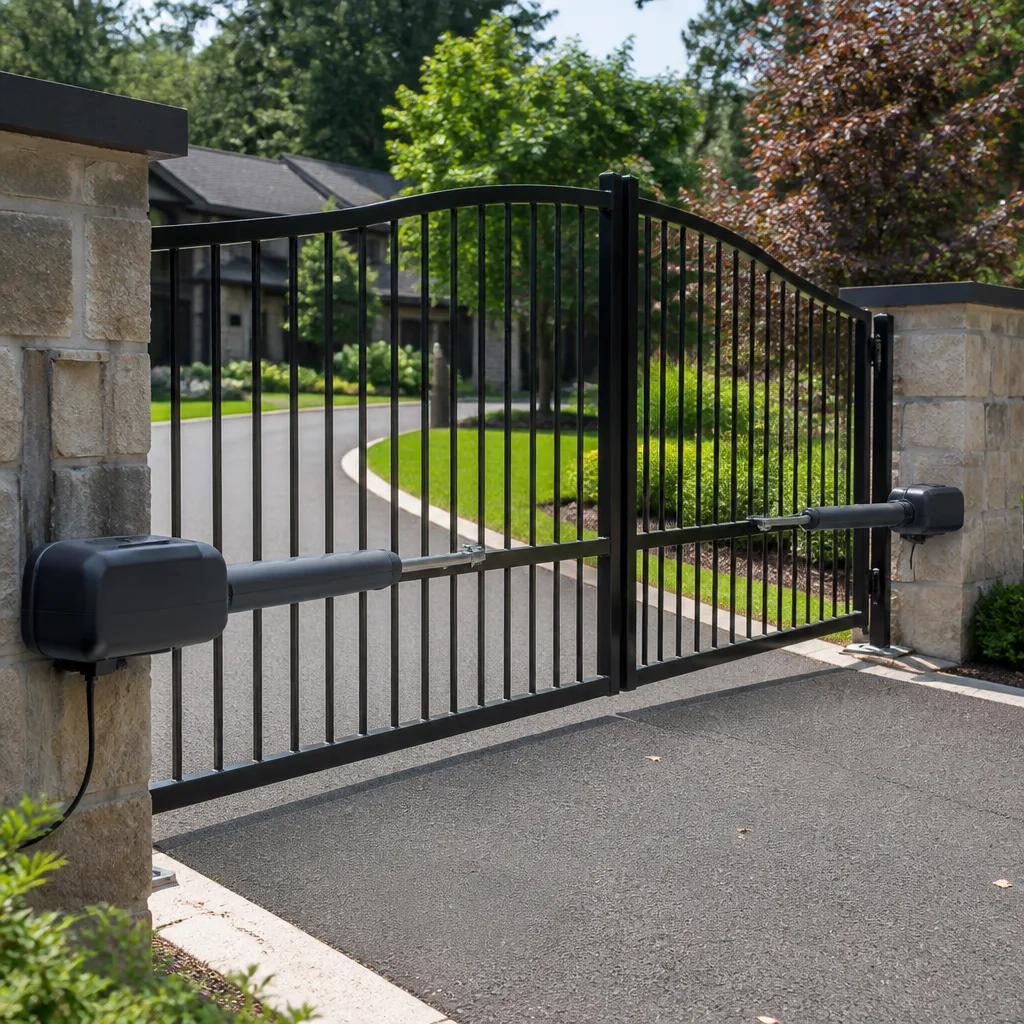
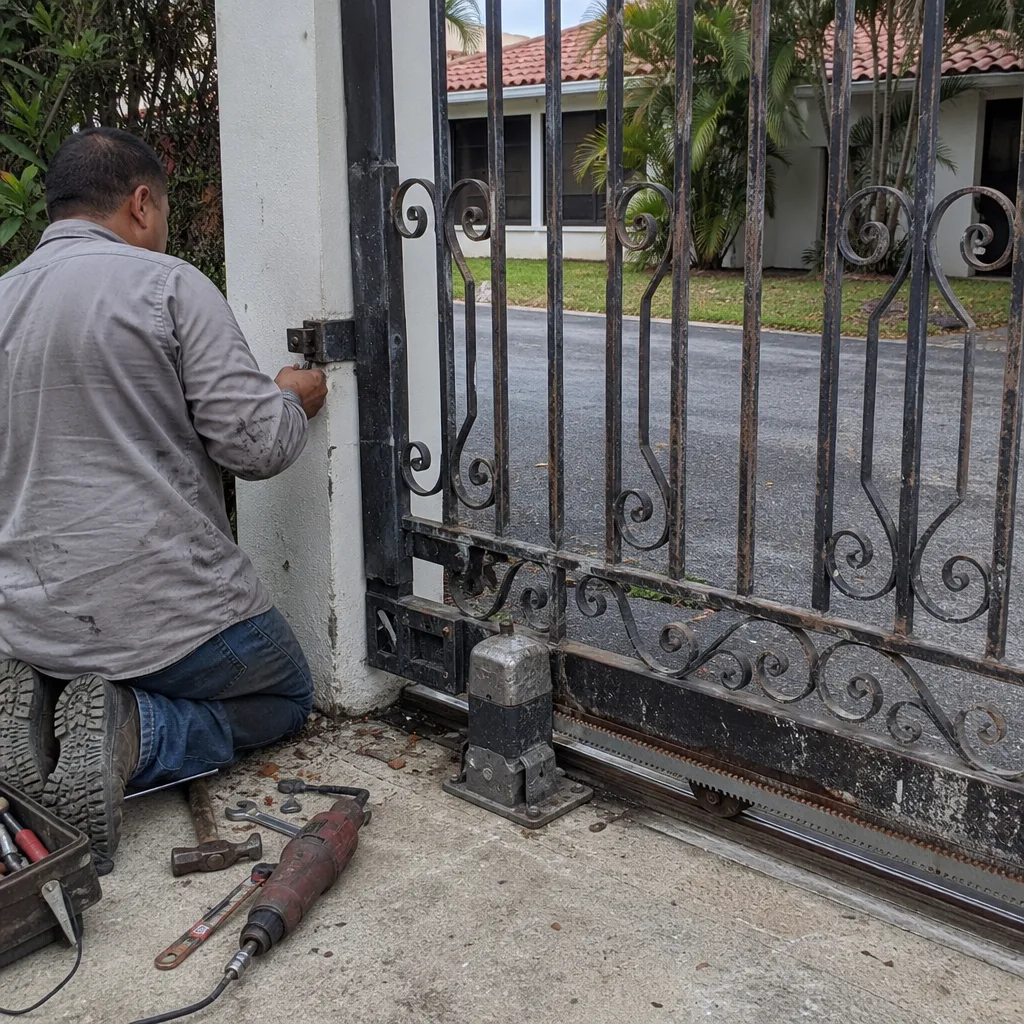 Before
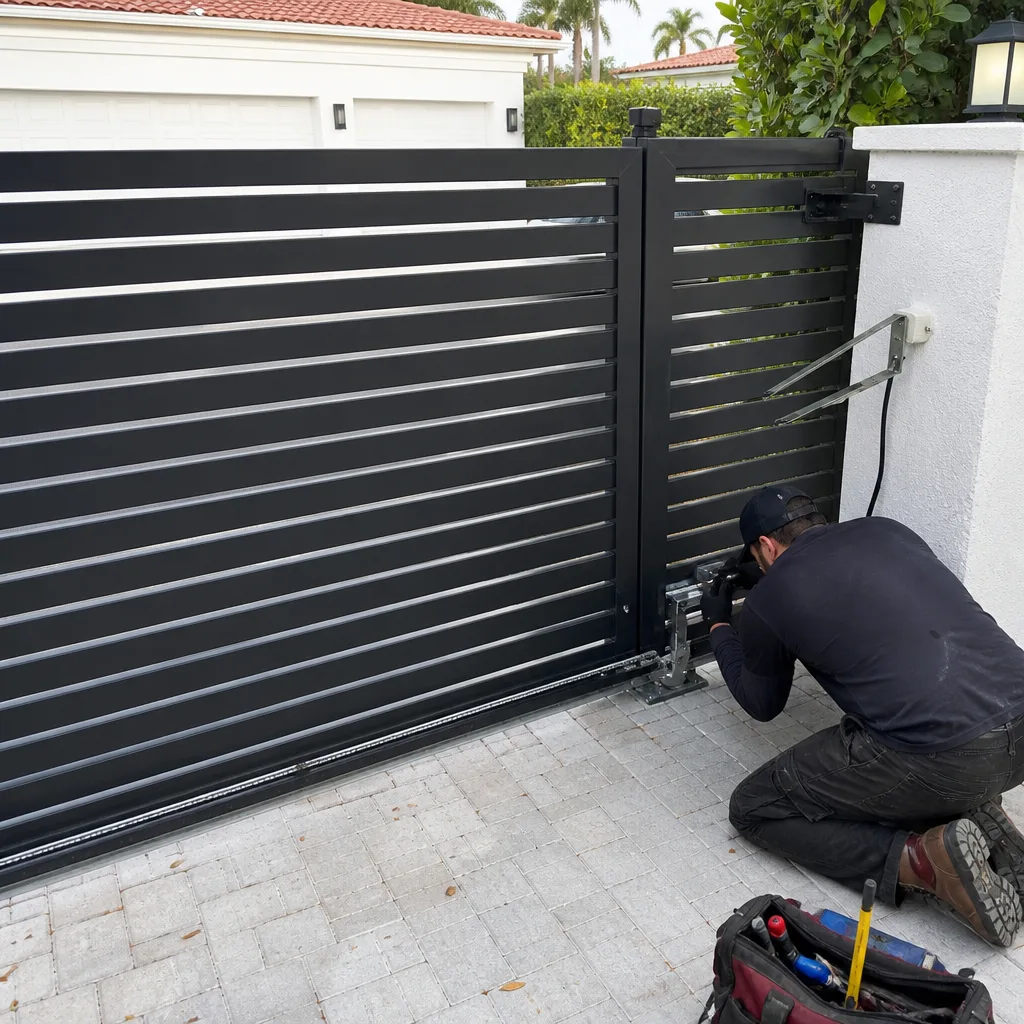 After
After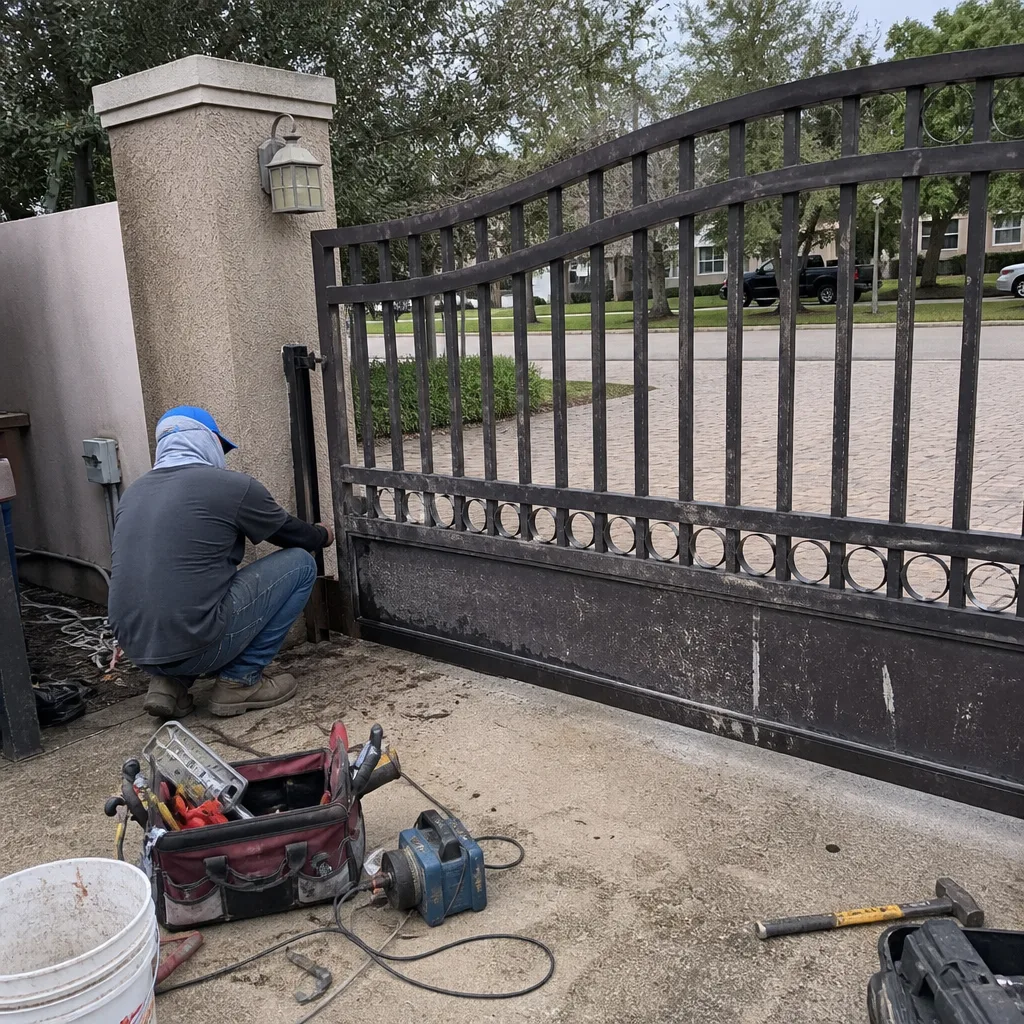 Before
 After
After Before
 After
AfterGate Repair Warning Signs: A Hollywood Homeowner’s Reference Guide
The sound your gate makes during the last six inches of travel is one of the most diagnostic data points a technician has, and it’s gone the moment the gate stops moving. Most Hollywood homeowners never think to describe it because nobody told them what normal sounds like. A gate that closes with a soft thunk and a faint motor whine is healthy. A gate that grinds, shudders, stalls, or goes quiet mid-cycle is telling you something specific. This guide covers the warning signs we see most often in gate repair in Hollywood, what each one means mechanically, what it costs to ignore it for 30 days, and how to describe the problem so a technician can arrive with the right parts on the first trip.
Quick Answer
Most gate failures that look sudden were producing evidence for weeks: grinding during the last few inches of travel, a longer pause before movement, a sensor light blinking in a new pattern. The most common warning signs in Hollywood are gate sag at the hinge, grinding or clicking from the operator, uneven gaps at the latch, rust streaking at welds, and track debris on slide gates. Ignoring any of these for 30 days typically turns a $150 adjustment into a $400-$900 component replacement. The fix is simple: learn what normal looks and sounds like, log changes early, and call Vance Gate Repair Hollywood home at (754) 714-5786 before the gate stops moving entirely.
Table of Contents
- Audio Taxonomy: What Your Gate Is Telling You
- Visual Symptom Index: Sag, Gaps, Streaks, Debris
- Electrical Warning Signs on the Operator Panel
- The 30-Day Cost of Waiting, by Symptom
- How to Log and Describe a Warning Sign Accurately
- Hollywood-Specific Factors That Accelerate Gate Wear
- Common Mistakes to Avoid
- When to Call a Professional
- Frequently Asked Questions
- The Bottom Line
 Before
 After
AfterAudio Taxonomy: What Your Gate Is Telling You
Every gate type has a baseline sound. A swing gate with a healthy arm operator makes a steady mid-range hum with a soft mechanical clunk at each end of travel. A slide gate on a chain drive sounds like a muted bicycle chain under load. A slide gate on a belt drive is quieter, closer to a low whir. When the sound changes, the gate is telling you something. The specific noise, and when it happens in the cycle, is the diagnostic. In Hollywood, where humidity and salt air accelerate wear, we hear the same audio signatures repeating across neighborhoods from Emerald Hills to the Lakes Section.
The Four Sound Categories and What They Mean
- Grinding during the last six inches of travel: The rack or chain is resisting at the end of the cycle. This usually means the limit switch is forcing the gate past its natural stopping point, the track has debris packed at the end, or the rear pulley or sprocket bearing is wearing out. The last-six-inches grinding is the one we wish more Hollywood homeowners caught early, because it’s the cheapest warning sign to fix and one of the most expensive to ignore.
- Clicking at the start of movement: A rapid click-click-click when the motor first engages is most often a failing start capacitor on swing operators, or a chain that has stretched and is jumping on the sprocket of a slide gate. With FAAC and BFT swing operators, a single sharp click at startup is normal; a repeated click is not.
- Humming with no movement: The motor is receiving power and trying to run, but something is holding it back. On a swing gate, it’s often a partially seized hinge or a hydraulic operator low on fluid. On a slide gate, the wheels may have rusted onto their axles or the limit nut is jammed against the stop. If this happens, release the operator before the transformer overheats.
- Silence where there used to be sound: A gate that goes completely quiet when you press the remote is usually an electrical problem at the board, a tripped breaker, or a failed transformer. Silence after a storm in Hollywood commonly means water intrusion in the control box. Do not assume it’s a dead motor; in our experience, silent gates are board or power problems more than half the time.
The Sound to Describe When You Call
Technicians listen for three things: the sound itself, where in the cycle it happens, and whether it’s getting worse over days or weeks. A grinding sound that only happens on the close cycle, specifically when the gate reaches the closed position, points to the close limit being set slightly too far. A grinding sound on both open and close points to track or hinge problems. A grinding sound in the middle of travel points to the chain, belt, or wheels. Write down the sound, the cycle position, and the date you first noticed it. That information alone lets a technician diagnose roughly half of all gate problems before arriving, and it’s exactly the kind of evidence-first log we encourage every Hollywood homeowner to keep.
Visual Symptom Index: Sag, Gaps, Streaks, Debris
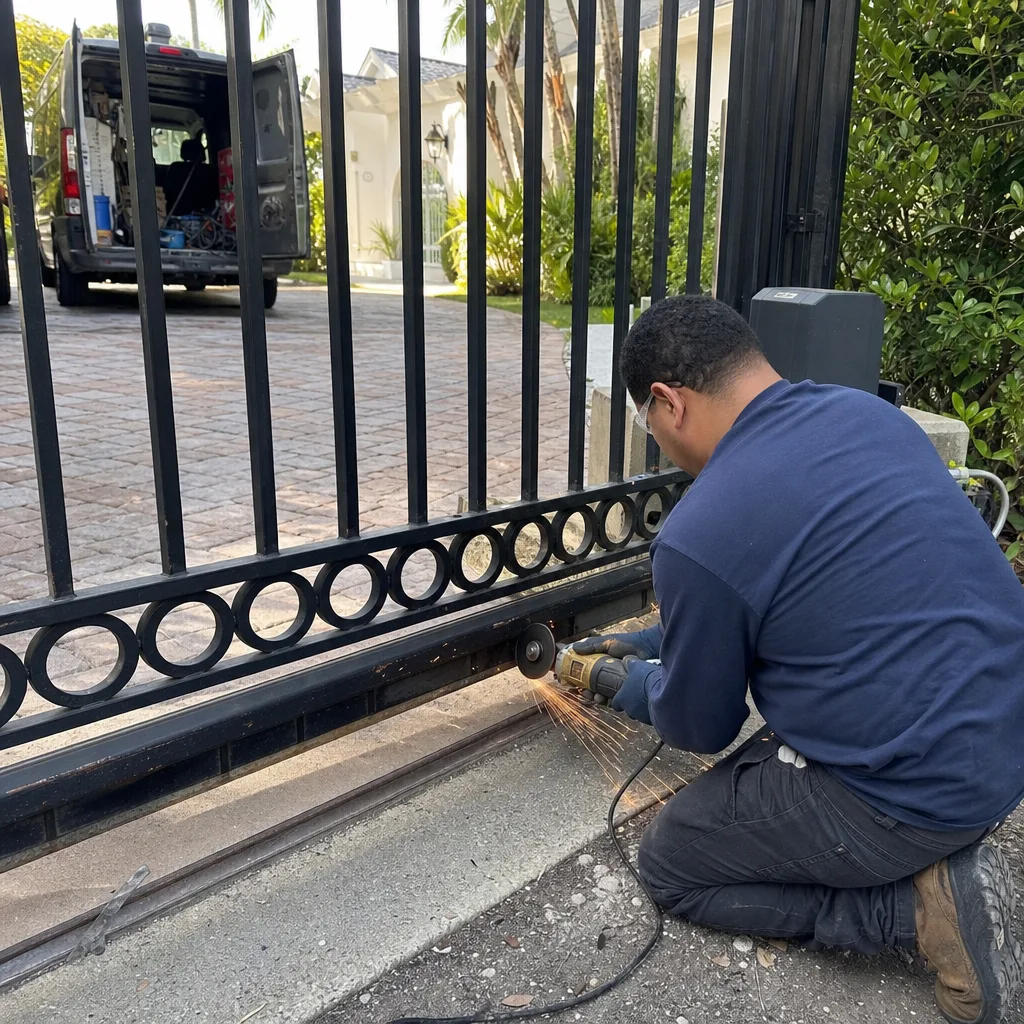
Not every warning sign is audible. Some of them are visible, and they accumulate slowly enough that you stop noticing them. The gate looked fine last month, but compare a photo from six months ago and the change is obvious. We recommend Hollywood homeowners take a phone photo of the gate from the latch side every few months. The photo log becomes your baseline, and the baseline is what makes a small complaint diagnosable. Here’s what to look for:
- Gate sag at the hinge side: A steel gate weighs anywhere from 300 to 800 pounds. Gravity works on it 24 hours a day. Over time, the hinge welds stretch, the hinge bolts elongate their holes, or the post itself leans. The standard test: measure the gap between the gate’s latch end and the ground. If the gap was even when the gate was installed and now the latch end sits visibly lower, the gate is sagging. Swing gates in Hollywood with west-facing exposure sag slightly faster because the afternoon sun heats the steel and accelerates metal fatigue at the hinge welds. A sagging gate doesn’t fix itself; the hinge pins wear unevenly, and a worn hinge pin will eventually shear under the load.
- Uneven gaps at the latch or frame: When a swing gate doesn’t meet the latch squarely anymore, it’s usually hinge wear or post movement. You may also see the gate binding at the bottom corner opposite the hinge, which is a sign the post has shifted and the gate is no longer in its original plane. Slide gates show uneven gaps differently: if the gap at the leading edge is wider at the top than the bottom, the gate has racked, and one of the carrier wheels has failed or the track has settled.
- Rust streaking at welds and bottom rails: Rust on a gate in Hollywood is not a cosmetic issue; it’s a structural timer. Rust streaks running downward from welds mean water is getting through the paint or powder coat and attacking the joint. A gate with rust at the bottom rail is losing material where the weight concentrates. Salt air from the Atlantic, particularly west of Federal Highway where the breeze carries moisture, accelerates this significantly. We see gates 14 years old with terminal rust at the welds and pivot points, and plates that are 25 years old only a mile inland that are still sound. If you see rust streaking, the time to act is measured in weeks, not seasons, especially at the hinge side where failure is catastrophic and dangerous.
- Track debris on slide gates: Slide gates run on a V-track or a floor rail, and the wheels ride that track constantly. Leaves, sand, driveway gravel, and soil all work their way into the track. A pinch of sand becomes a grinding paste under a 600-pound gate. Debris at the end stop compresses and forces the gate off limit, which causes the grinding we covered above. During Hollywood’s summer storm season, a single thunderstorm can wash enough sand and leaf material onto the track to change the gate’s sound within 48 hours. The track should be cleaned regularly; it’s the easiest maintenance item on a slide gate and the one most often skipped.
- Gate leaves not level with each other: On a dual-swing driveway gate, both leaves should meet at the center with even gaps top and bottom. If one leaf arrives at center a half-inch high, you have independent hinge wear. That leaf is doing more work at the weld, and it will fail first. Catch that half-inch early and the fix is a hinge adjustment. Wait until the leaf drags the driveway on every cycle and you’re often replacing the hinge assembly or the entire leaf.
Why These Visual Signs Get Missed
Homeowners in Hollywood drive through their gates every day without looking at them. The gate is either open or closed, and the eye registers only that binary. The sag, the gap, the streak at the weld: none of it reads as urgent because none of it changes the gate’s function that week. But each of these is a proof point that the gate’s structure is working, right now, against its own hardware. A professional inspection doesn’t cost much relative to the alternative. As part of our documented visit process at gate installation in Hollywood, every repair appointment includes a visual check of the hinges, weld points, and track condition, and we leave you the photos. If you’re not sure what you’re looking at, a photo taken today is still better than a guess made next month.
Electrical Warning Signs on the Operator Panel
The operator panel is the brain of the gate, and it has a small set of visual cues that read like a dashboard. No technical training is required to read these warning signs; you just need to know what the lights mean for your specific brand. LiftMaster, FAAC, BFT, Linear, Viking, DoorKing, Elite, and Mighty Mule all have slightly different indicator patterns, but the underlying logic is the same: a solid light means normal, a blinking light means a condition, and a pattern of blinks is a code you can look up.
What You Can Read on the Panel Without Opening the Housing
- Power light is off: The board is not receiving power. Check the breaker first. In Hollywood, a storm surge can trip a GFCI outlet that powers the operator. If the outlet is live and the board is dark, the transformer or the board has failed. A dark panel with a warm housing usually means a short or a failed component; a dark panel with a cold housing usually means no power is reaching the unit at all.
- Power light is on but the diagnostic LED is blinking: Most brands use a blink pattern or a numeric display to indicate a fault. A single blink on a FAAC board often means the photo-eye is blocked or misaligned. Two blinks on a BFT board can mean force limit exceeded, meaning the gate met resistance and stopped, usually because of debris, hinge wear, or a physical obstruction. Three blinks on a Viking board can indicate a safety edge was triggered. Write down the pattern or take a short video of it before calling anyone.
- Photo-eye LED changes from steady to blinking: The photo-eye is the infrared beam that stops the gate if something crosses the path. A steady light on the receiver means the beam is aligned and healthy. A blinking receiver light means the beam is weak or broken. A blinking pattern that starts after rain often means water got into the housing and is shorting the eye. A beam that is misaligned by just two inches can cause intermittent failures that make a gate appear haunted: it stops for no reason, won’t close at night, or reopens after closing halfway. This is a repair, not an adjustment issue if the housing is cracked or wet inside.
- Remote control works intermittently: An intermittent remote is rarely the remote itself. It’s usually the receiver antenna, a low battery in the remote, or RF interference from a new nearby device. But if multiple remotes fail at the same time and the panel light is on, the receiver circuit on the board may be failing. In Hollywood, where many homes have dense electronic environments inside and outside the house, RF interference from new LED drivers, security cameras, and solar inverters has become more common in the last few years. The antenna position matters more than most homeowners assume.
The Most Common Operator Panel Warning Sign in Hollywood
The pattern we see most is a blinking power LED combined with a gate that moves slowly and then stops before the closed position. That pattern usually means the operator’s force setting is too low, often after the hinges were serviced or the gate was repainted, and the board is interpreting the added resistance as an obstruction. Adjusting the force setting is part of a routine service; replacing the board because the motor burned out is not. A homeowner can read the blink pattern, but a technician should be the one to change the force setting, because force that is too high defeats the safety function and force that is too low shuts the gate mid-cycle.
The 30-Day Cost of Waiting, by Symptom
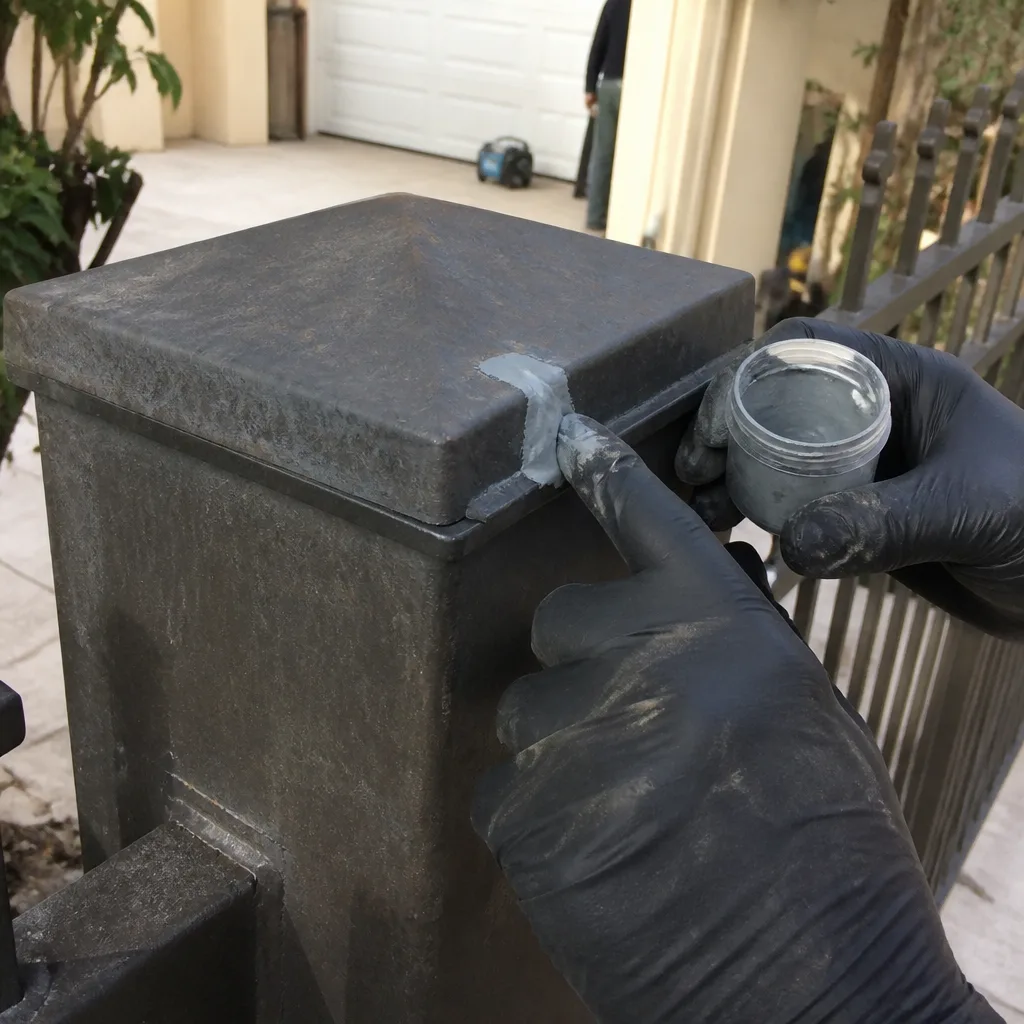
What does it cost to wait 30 days? The answer depends on the symptom, but the pattern is consistent: the cheap repair becomes an expensive replacement when the warning sign is ignored. Here is a specific breakdown of the most common progression we document in Hollywood, with dollar ranges based on what we’ve seen on gates across Broward County over the last several years.
Cost-of-Waiting Breakdown Table
- Symptom: Grinding during the last six inches of travel. 30-day cost if addressed now: $85-$150 for a limit-switch adjustment and track cleaning, depending on the operator type and gate size. 30-day cost if ignored: $400-$900 for a chain and sprocket replacement, rack repair, or rear pulley bearing replacement.
- Symptom: Gate sag at the hinge side. 30-day cost if addressed now: $120-$250 for hinge shimming, hinge bolt replacement, and a realignment, assuming the post is sound. 30-day cost if ignored: $600-$1,600 for a post reset, hinge assembly replacement, or full gate leaf replacement when the weld tears through the top rail.
- Symptom: Humming with no movement. 30-day cost if addressed now: $90-$200 for a clutch adjustment, hydraulic top-off, or hinge service. 30-day cost if ignored: $350-$800 for a motor replacement plus a new capacitor and possible board damage from the repeated stall.
- Symptom: Rust streaking at welds and bottom rails. 30-day cost if addressed now: $150-$350 for surface preparation, rust conversion, priming, and touch-up coating at the affected welds. 30-day cost if ignored: $900-$2,500 for structural re-welding, section replacement, or full gate replacement.
- Symptom: Photo-eye blinking or intermittent gate reversal. 30-day cost if addressed now: $65-$125 for a realignment or a photo-eye replacement. 30-day cost if ignored: $250-$500 when the gate runs into a vehicle or a pedestrian, causing damage to the gate, the operator, and whatever was hit.
- Symptom: Remote works intermittently. 30-day cost if addressed now: $40-$100 for antenna repositioning, a new remote battery, or reprogramming. 30-day cost if ignored: $200-$450 for a new receiver board or control board replacement.
- Symptom: Track debris on slide gate. 30-day cost if addressed now: $0-$60 for a track cleaning or $80-$150 for a wheel and track service. 30-day cost if ignored: $350-$700 for worn carrier wheel replacement and possible track repair.
Notice the pattern: the intervention that costs $100 this week becomes a $500 or $1,000 repair in 30 days. The reason is not that the problem changes; it’s that the damaged component takes out another component. A worn hinge pin takes out the hinge housing. A stretched chain takes out the sprocket and the motor coupler. A dirty track takes out the carrier wheels. Gate systems fail in cascades, and the cascade starts with a small warning sign that was visible and loud and measurable.
These are the price ranges we quote in writing before any work begins. The flat price is handed to you before a tool is picked up, so you’re never facing a number you didn’t authorize. Under our Haven Standard, the price on the written estimate is the price on the invoice, and every adjustment is documented in a photo log that stays with the job file. When we do gate motor and opener service in Hollywood, the goal is to stop the cascade at the first symptom, not to chase it after the fact.
How to Log and Describe a Warning Sign Accurately
The quality of the information you bring to a technician determines whether the first visit is the only visit. When a Hollywood homeowner calls and says “the gate is making a noise,” the technician has to diagnose remotely without data. When the homeowner says “it grinds during the last six inches of the close cycle, and it’s getting louder over two weeks,” the technician can prepare the parts and budget the time before leaving the shop. Here’s how to log a warning sign the way a professional would:
Step 1: Record the sound with a phone video.
Stand six feet from the operator and film the gate moving through a full open and close cycle. The audio pattern in the video is often enough for a technician to identify the problem as a chain issue, a hinge problem, or an operator issue. Send the video when you call.
Step 2: Note the cycle position.
Does the sound happen on open, on close, at the start, at the end, or throughout? Each position maps to a different set of causes. Write it down as one line: “grinds on close, last six inches” or “clicks on open, first two seconds.”
Step 3: Note what changed and when.
Was the sound there Monday but louder on Thursday? Did the gate start pausing mid-cycle after the last storm? Did the remote start failing after you installed new landscape lights? Change-over-time is the most underused diagnostic data in gate repair.
Step 4: Check the panel for blink patterns.
Take a photo or video of the operator panel lights when the gate is at rest and when it’s moving. The blink pattern is a code. A technician who sees the video can often tell you the fault category before reading the control board’s manual.
Step 5: Measure the mechanical visible signs.
Use a tape measure to check the gap at the latch, the height of the gate at the hinge versus the latch end, and the distance between the gate leaves at top and bottom. Write the numbers down. A half-inch difference in the latch gap is meaningful; a two-inch difference is urgent. Numbers beat adjectives.
Under our standard procedure at Vance Gate Repair Hollywood, every visit leaves a documented photo record of what was found, what was adjusted, and what was installed, so no future technician has to guess and no homeowner pays twice to rediscover the same problem. That’s the documentation habit Adrian Vance built on commercial access-control sites starting in 2014, and we apply it to every residential gate in Hollywood.
Hollywood-Specific Factors That Accelerate Gate Wear
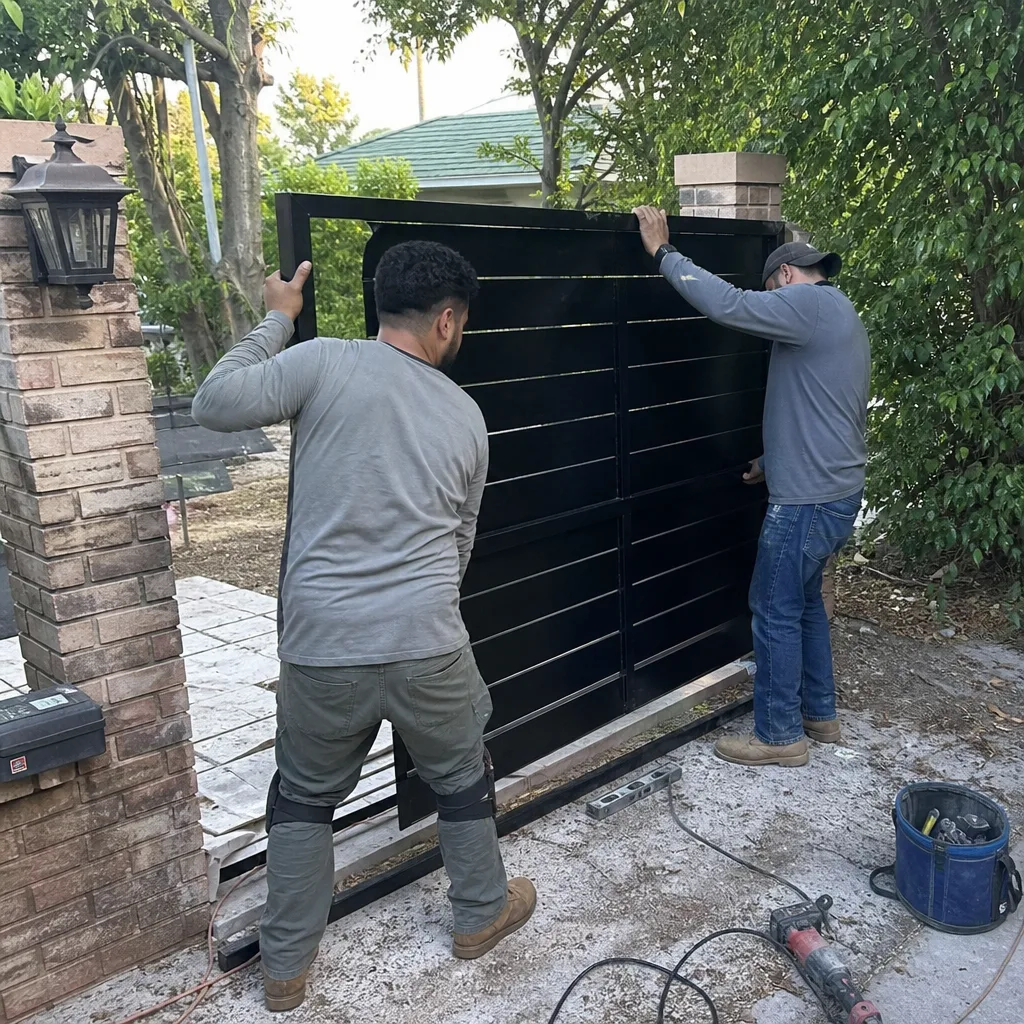
Gate systems in Hollywood wear differently than gates in Orlando, Tampa, or Miami. The environment here is specific and unforgiving. Understanding the local conditions explains why a gate that lasted 15 years in a moderate climate fails in 10 here, and it tells you what to watch for as a Hollywood homeowner.
Salt Air and Coastal Humidity
Homes west of Federal Highway and east of US-1 live in a salt-air band that accelerates rust on every ferrous metal surface. Gate hinges, chain drives, track fittings, and control board contacts all corrode faster within two miles of the Atlantic. The rust streaking symptom we covered earlier appears on Hollywood gates in this zone years earlier than on identical gates just a few miles inland. A chain that would last nine years in Davie might last six in the Hollywood Lakes section. The takeaway is not that gates fail here; it’s that the warning signs appear sooner, and the 30-day cost of waiting is more compressed.
Afternoon Heat and Direct Sun
Hollywood gets intense afternoon sun, especially on west-facing gates. The steel heats to 140 degrees or more in July and August. That heat expands the metal. Over hundreds of daily cycles, the expansion and contraction works the hinge welds and the rack joints. Gates with dark powder coating absorb more heat and show weld fatigue earlier. The heat also shortens capacitor life in the operator’s control box if the box is mounted in direct sun without shade. A capacitor that would last eight years in a shaded spot can fail in four bolted to a south-facing wall.
Storm Season and Track Washing
Hollywood’s summer storm pattern delivers sudden, intense rainfall that washes sand, leaf litter, and driveway aggregate into slide-gate tracks. A two-inch rain in 45 minutes can move enough debris to change the gate’s sound within two days. Homeowners who check the track after every storm catch debris before it compresses at the end stop. Homeowners who don’t, call us when the gate stops moving at the halfway point. The storm season is May through October, and it’s the busiest season for gate failures in Hollywood.
Older Gates in Established Neighborhoods
Hollywood’s housing stock includes a large inventory of homes built between the 1950s and 1980s. Many of these properties have gate hardware that’s been in place since the 1990s or early 2000s. The automation may have been updated, but the gate’s physical structure, the hinges, the posts, and the track, haven’t been touched. The operator can be modern while the gate it moves is 25 years old. A homeowner with a new LiftMaster bolted to a 1980s hinge post has a system that’s only as reliable as its oldest component, and that component is showing visual wear long before the operator panel blinks.
Common Mistakes to Avoid
- Greasing the track without cleaning it first. Household grease on a slide-gate track collects sand and turns it into a grinding paste. The track should be cleaned, not lubricated. Adding grease without removing the abrasive debris accelerates wear.
- Replacing the remote when the problem is the receiver. A failing remote is an easy assumption, but when two remotes fail at the same time, the receiver board is usually the problem. Replacing the remote one at a time delays the real fix and wastes money.
- Repainting over rust without treating the metal. A fresh coat of paint over active rust traps moisture and makes the corrosion worse. The rust has to be removed or converted before the coating goes on. We see this specific mistake on Hollywood gates every month, where a quick repaint looks good for a year and then flakes in sheets.
- Assuming a silent gate means a dead motor. More than half of the silent gates we diagnose in Hollywood have power or board problems, not motor failures. The motor is often the last component to die. A homeowner who assumes a dead motor may approve a full replacement when a $150 board repair was the actual fix.
- Waiting for total failure before calling. The most expensive mistake is treating the gate as something that either works or doesn’t. Gates fail in stages. The grinding, the sag, the blinking photo-eye are all stages. Catching the stage means a small repair; waiting for the collapse means a replacement.
- Using a generic handyman for a branded operator repair. A Viking board is not a FAAC board. A BFT limit adjustment is not a LiftMaster limit adjustment. A general handyman who is not familiar with the specific brand can turn a $150 adjustment into a $600 board damage. We service nine major automation brands, including FAAC, BFT, Linear, and Viking, and the difference shows in the number of first-trip fixes.
- Never measuring anything. The homeowner who calls with measurements, a video of the sound, and a photo of the blink pattern gets a faster, cheaper, more accurate repair than the homeowner who says “it’s broken.” Data is free and it saves real money.
When to Call a Professional
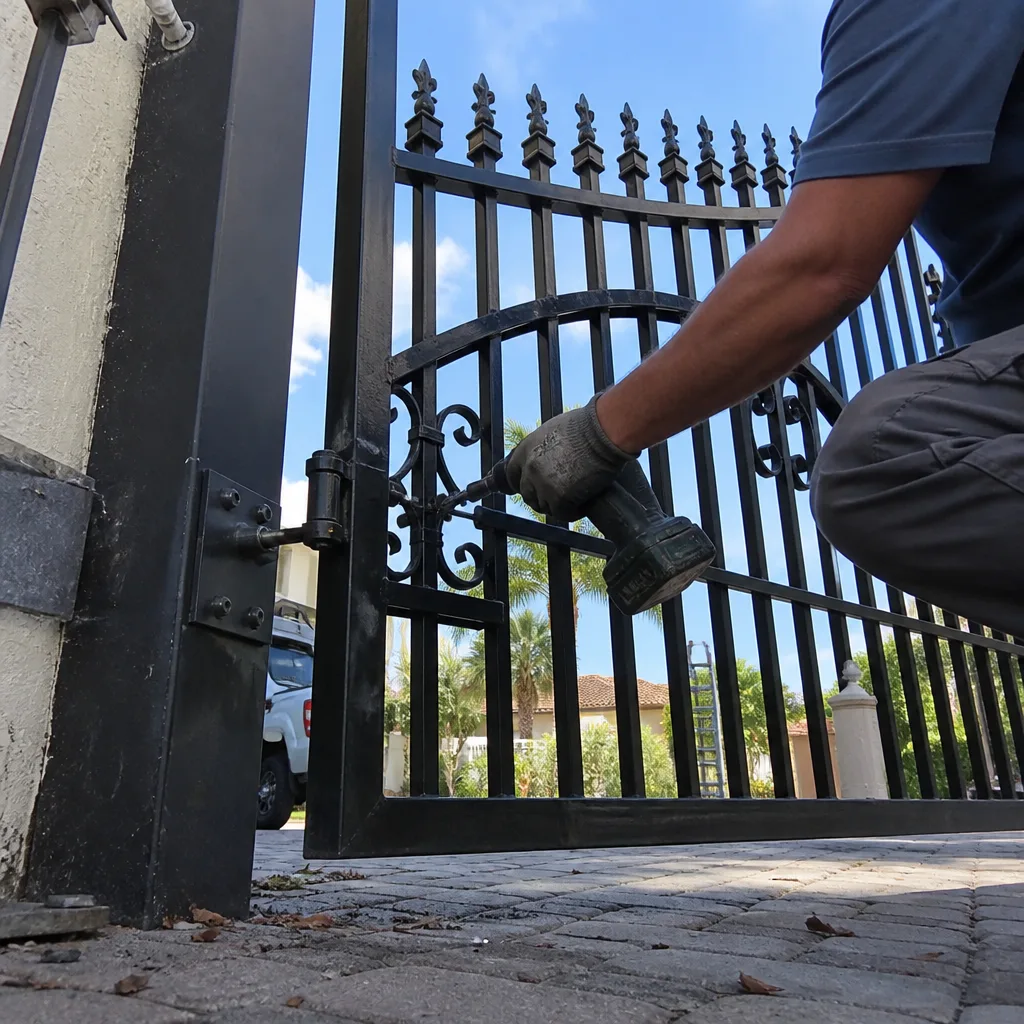
Call a professional the day you notice a sound, a gap, or a light that wasn’t there before. The warning signs in this guide are all pre-failure conditions, and every one of them is cheaper to address this week than next month. Specifically, call if the gate grinds, hums without moving, sags at the hinge, shows rust streaking at a weld, blinks an unusual pattern on the panel, or stops and reopens mid-cycle. If high-tension springs or cables are involved, do not attempt to adjust them yourself; a spring under load can release with enough force to cause serious injury. Vance Gate Repair Hollywood offers free estimates in Hollywood, and a live person answers (754) 714-5786 at any hour, seven days a week. No voicemail loop, no callback queue.
Frequently Asked Questions
The most common warning sign in Hollywood is grinding during the last six inches of travel on the close cycle. It usually means a limit-switch misadjustment or track debris, and it costs $85-$150 to fix if caught early. Ignored for 30 days, it often becomes a $400-$900 chain, sprocket, or pulley failure. Call (754) 714-5786 to describe the sound and we’ll give you an exact written price before any work starts.
A gate that hums without moving means the motor is receiving power but something is preventing movement, most often a seized hinge, a low hydraulic reservoir, or a jammed limit nut. The transformer will overheat if the gate remains in a stalled state for more than a few minutes. Release the operator and call for service; this pattern usually costs $90-$200 to fix if it hasn’t burned out the motor yet.
The photo-eye indicator light will blink or go out when the beam is broken or misaligned. If the beam was working and the light starts blinking after rain, water has likely entered the housing and shorted the eye. If the light is steady but the gate still reverses, the issue may be the force setting or the board’s input, not the eye itself. A photo-eye replacement or realignment typically costs $65-$125.
Yes, most repair calls in Hollywood are completed the same day, often within hours of the first call. Gate repair in Hollywood is the core of our business, and we stock the common replacement parts for FAAC, BFT, Linear, Viking, LiftMaster, and DoorKing on the trucks. The description and video you provide before the visit is what allows us to carry the right part on the first trip.
A full gate installation in Hollywood includes the gate structure, the hinges or track, the operator and arm, the safety photo-eyes and edges, the control board and receiver, and the full power run to the operator location. The written scope and written price cover the entire job, and the photo record documents every component installed. Most installations are completed in one to three days depending on the gate type and the condition of the existing posts.
Gate motor replacement in Hollywood typically runs $500-$1,400 installed, depending on the brand, the gate type, and whether the existing arm bracket and limit assemblies can be reused. A FAAC or BFT swing operator replacement costs more than a Mighty Mule residential replacement because the duty cycle and the safety inputs are different. We quote a written flat price before any work starts, and the price on paper is the price on the invoice. Call (754) 714-5786 for a free exact quote.
The Bottom Line
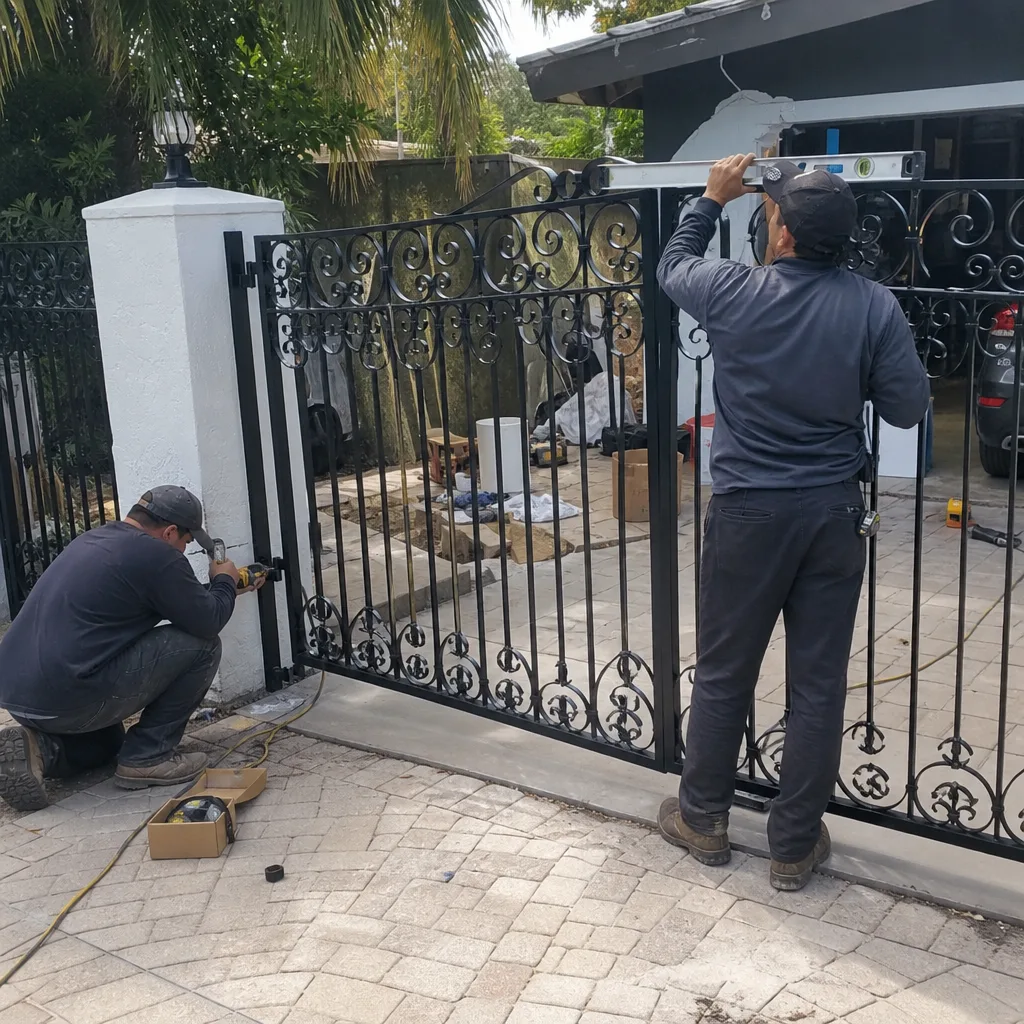
Gate failures in Hollywood are not random. They announce themselves through sounds, visual deformations, and panel blink patterns that are readable to any homeowner who knows what to look for. The grinding in the last six inches of travel, the sag at the hinge, the rust streak at the weld, the blinking photo-eye: each is a specific signal that maps to a specific repair, and each is dramatically cheaper to address now than in 30 days. Gate systems fail in cascades; a worn chain takes out a sprocket, a seized hinge takes out a motor, a dirty track takes out the carrier wheels. The homeowner who logs the symptom, photographs the panel, and calls before the cascade starts is the homeowner who pays $150 instead of $900. Vance Gate Repair Hollywood exists for that homeowner: a live person answers 24/7, the price is written before any work begins, and every visit leaves a documented photo record of what was found, what was set, and what was installed under the Haven Standard.
Written by Adrian Vance, Owner at Vance Gate Repair Hollywood, serving Hollywood since 2014.